Tuesday, May 28, 2024

RPI Day 5: Planning a Reading Programme

 Today's session was all about planning a reading programme. 

It was great to have the reminder about why our use of sites is so important for our students learning. It brings back the purpose and has made me think about how I utilise my site for reading, and whether I could lay it out in way way that my students would get more from it. I think I may be cramming too much onto the slides rather than the site.

There were a few resources that I found today that I would like to explore more and use it in my programme. 

Epic - we currently use this and I have recently been exploring it a bit more. I thought that it was cool to see that there are texts to support different writing genres too. 

Readworks - I think this will be a really good one to replace read theory with a bit more customisation to the learning intentions we focus on. It is a bit more targeted and controlled than read theory. 

I am also keen to look at Muzify, I think it will really engage our students into thinking about their texts.
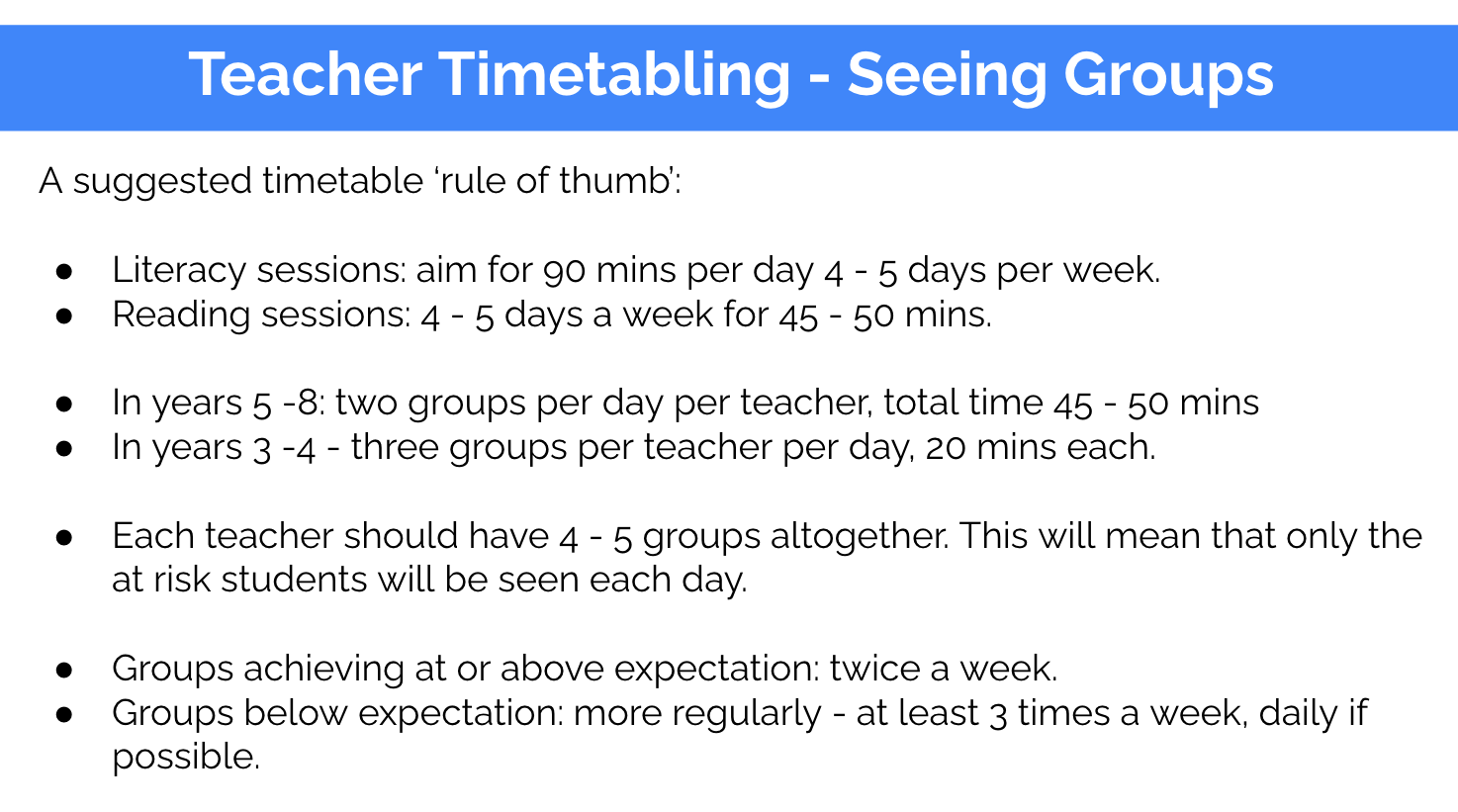
It has been good to think about our timetabling in our class. I wonder if I am trying to do too many groups each day and whether building some conferencing into the reading programme to support the independent learning task would be beneficial for task completion and supporting students to get more out of the tasks they are completing.

I am also going to look at the Mahi tracker in digital form. I liked the idea of the sparkline as I think that will be a good motivator for students to see their work completion and for me to quickly see how they are progressing with their work across the week. I was also mind-blown to learn that you can protect cells in a sheet so only the people who are shared into that particular cell or row can make changes to it. This means that the Mahi tracker can be shared but students can only tick and link things on their own row.  
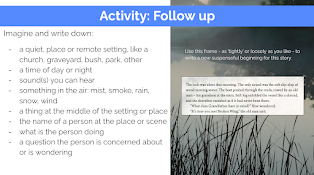
   

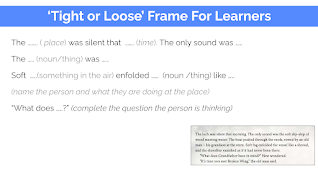
I really liked the session on Read Like Writers, Write Like Readers. Focusing on structures within texts they are reading to support structures in writing is a powerful way to teach. The activity we did in writing our own paragraph made it feel achievable to write an effective paragraph. By starting with those question prompts, only having to think of the keywords, it made it easy to then fill in the gaps to create sentences, it also meant that when filling in the gaps the cognitive load wasn't on what was happening as much but filling out the details in sentences. It was nice to be in the position of our students, to see how they might feel. 

The things I want to try from this session are:

  • Using some of the digital follow-up activities more effectively, like Epic and read works.
  • look at my learning site and timetabling. Can they be use more effectley?
  • introduce a digital mahi tracker
  • for next term look at ways to plan mult level text sets a a team to make planning more efficient and effective.
  • begin to use texts exerts as examples of effective writing with the students to integrate reading and writing more effectively. 

Friday, May 10, 2024

RPI Day 4: Guided Reading

The session about guided reading has given me lots of practical ways to support learners and direct guided reading. 

I think today's focus really helped me to think about the intention in my planning and how to get the most out of the time I have with the group.

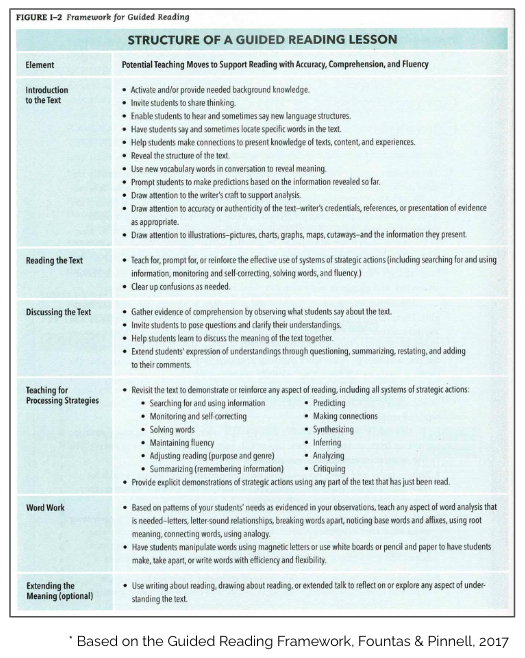
I really liked how it brought us back to the structure of the guided reading lesson. I think this was a good reminder to keep the reading lessons structured and have a clear purpose. I think often with my groups, especially with our school focus being on extended discussion, I can get caught up in the discussion part of a lesson. I am going to be using the structure to guide my planning and to be more intentional.

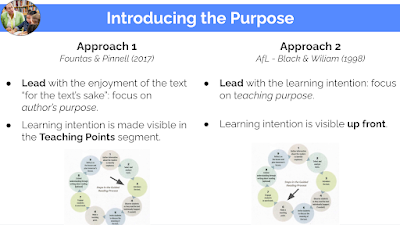
I also found the approach to the lesson a useful point. I often feel that we start our lessons by introducing the learning intention but the teaching doesn't come until later so the link for the learner may not be as clear or explicit for our learners.  By considering our purpose and approach we can make the most out of the explicit teaching moments, keeping them short and concise, while still getting what we intended to out of it. It can also mean we are able to promote the enjoyment of the text and discussion without it getting lost in the 'teaching point'. 

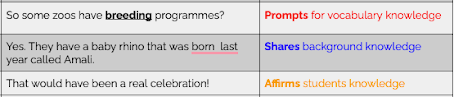
It is important to think about your purpose and approach when activating knowledge. Make sure your questioning is specific to get out of the activation what you intend, relating to the text schema. It is easy for prior knowledge to lead off on a tangent and lose connection with the intended purpose. Even the way you pose questions can change what you get from the students. I like this example from the activity we did. The teacher asked a question about breeding programmes and still got the information about what her students know about the term breeding.

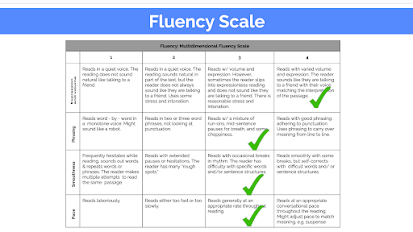
It was great total about ways to observe our reader fluency. in the senior school when students have moved from the learning to read to the reading to learn phase we often forget to observe the reading aloud of students who are reading to learn. These observations are important for us to understand their reading fluency. This section gave some good tips for observing the reading aloud. Using the recording of reading to observe will be helpful as it can be done outside of the classroom time which can help us to meet needs by focusing on what our students need. I plan to use this approach by continuing with the recording of the reading. I did like the fluency rubric too. I think it would be great to add to the slide where the students record their reading so that they can self-asses their own fluency. I also liked the point that it is Ok to use the correct or more academic terms with students (for example, intonation), we just have to teach what that means.

There were also a lot of great resources and ideas for us to use. The idea of having a play on your site for graphic organisers and teaching students to find the one they need creates independence for the students and is time-saving for us. I like the anticipation guides and use of KWL charts etc to build prior knowledge, depending on the topic and purpose they could be used prior to coming to the group session.

I am looking forward to putting these things into practice and being more intentional with my planning for guided reading. I am hoping that this can back to the teaching rather than the instructions (as Georgie said), and give my groups more time to focus on the key teaching and having those deeper extended discussions.

The Kahoot was also a great way to finish and consolidate our knowledge, even though it was a little bit stressful. I wonder if that is how some of our students feel when we give them those kinds of tasks? It was great to come second though 😂 I am not usually that competitive!

Friday, April 5, 2024

RPI Day 3: Text Selection

Hi Everyone, 

This week's focus was on how we group students and select texts for our students. 

As always, I enjoyed hearing Dorothy talk about the kaupapa and pedagogy. I really like the practical ideas that I can take away. The use of voice typing for students to transfer texts to digital texts. This term I have been starting to get students to record themselves reading, I really liked the idea of having the students save it to a media folder and being able to have that as a record of their reading and a form of formative assessment. 

The discussions around the grouping of students were really interesting and made me think about how I am doing things in my class and across our hub. We tend to group based on levels or close levels but we could be looking at learning intentions or interests and finding ways to scaffold texts to help them access a larger range of texts and using AI to help create or alter texts to meet needs. This is an area I want to explore more next term. I found this slide useful in breaking down some of the considerations, and think it will be useful to go back to when considering groupings.


Over the last few years, I have done a bit around text selection and in general, I try to think about the texts I am choosing. In the past, I have played around with using supporting texts and some T-shaped literacy but it is not something I have done consistently. I think that this is going to be a goal for me next term to build up some text sets be really purposeful in those text selections and develop some consistency.

I found a lot of value in the quick stock-take activity. It was good to see that I have quite a few elements in my program and reflect on what I can do to optimize and add variety to include more variety.


I think that the next step in my team is to evaluate the elements in our reading program, find out what we are consistently doing across our hub and see what areas we could improve on. It will also be good to look at our inquiry topics this year and see what we can integrate with texts sets that can be useful to all of us.

Thanks for reading. 

Friday, March 8, 2024

Reading Practice Intensive, Day 2: Know Your Reader

Hi Everyone, 

I have really enjoyed Day 2 of the RPI. It has been so good to dive deeper and get to know our own readers better. It has been really good to get to do this by looking at our own data.

I enjoyed hearing a little more about the Kaupapa and the pedagogy behind what we are doing. I felt that the information about literacy cycles was very valuable, bringing it back to the process and intention behind our planning. I really liked the connection between the shared aspect and motivation to complete work. If we are creating opportunities for them to show learning in exciting ways that they want to share they are going to have more motivation to complete the task. This idea of students creating podcasts was really cool. 

It was interesting to see how I can utilise the Teacher workbook. It seems like a great place to keep track of the data and monitor groups. It will hopefully make the next steps clearer and also help to track what we are doing over the year. It does seem quite overwhelming at the moment as there is a lot of data to add in there which will be quite time-consuming, but I think it will be worth it once it is all in there.

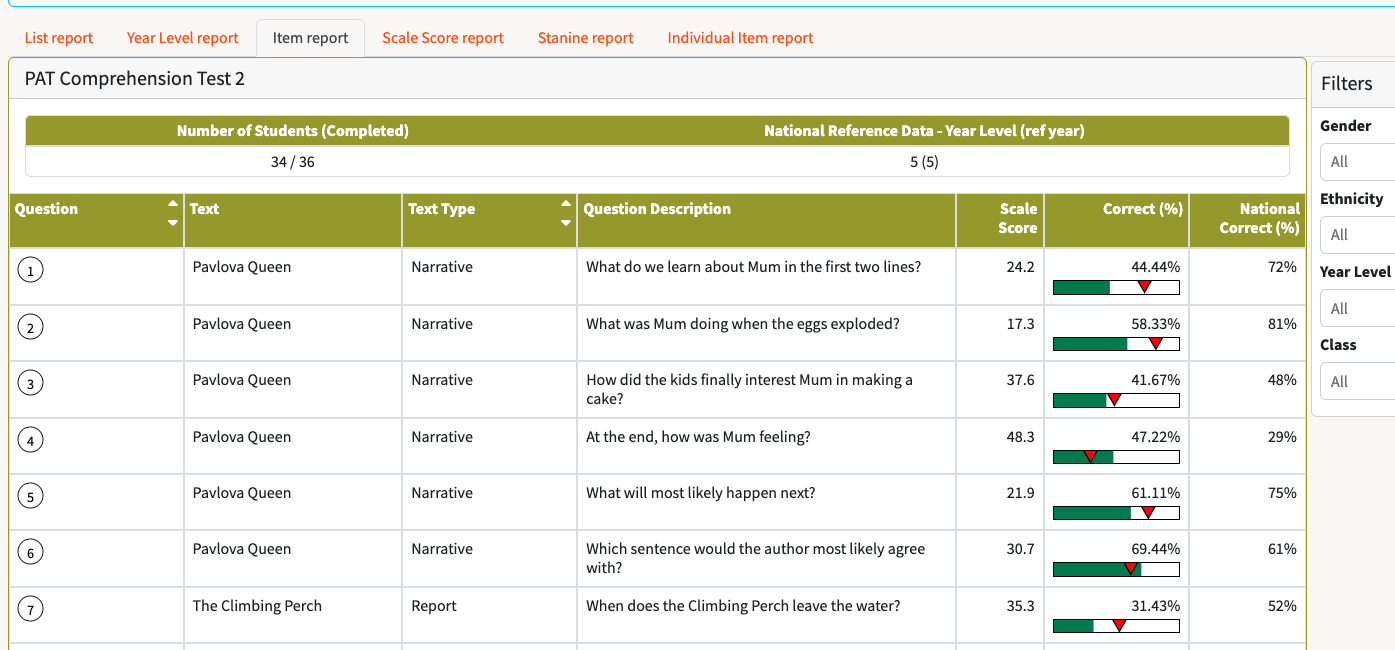
I really liked getting some tips to be able to utilise my PAT results better.
It hard hard with our reading classes being different from our homeroom classes as the data is not in sets so we will have to look across classes for individuals. Adding the information to the reading tracker sheet will hopefully help with this though. The connection from the PAT to ARBs is such a cool function to include activities connected to the skills. It is great to have activities that so clearly relate to the skills we are focusing on teaching. 


Where to next:
-look deeper into finding out the why behind why students aren't choosing to read in their own time. What can we do to change this?
-use the reading challenge, and add in some other tasks such as creating a podcast to review the book.
-look at the PAT data to find out the next steps for my groups
-Use some ARB activities in my teaching
-look at how to incorporate the taskboard with our current slide format. We use this team-wide and the format has been working well for us and the students 


Thursday, March 7, 2024

Reading Survey Data Analysis

Kia Ora Reader, 

Here is the data from my reading classes' student survey. 

I found it really interesting that the student's attitudes towards reading and their view of themselves as a reader was overall quite positive, they understood that reading helps them but they don't tend to read in their own time for enjoyment, though they did mostly enjoy reading for enjoyment. It will be interesting to did deeper with them to find out what the barriers are to reading and figuring out ways increase their motivation to read for enjoyement. 

Friday, February 16, 2024

RPI - Day 1: Reading is Core

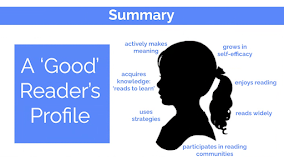
I felt that today was a great introduction to the RPI. It helped to bring our students as readers to the front of our minds and gain a deep understanding of what skills our readers need to be successful readers.


I enjoyed having a bit of a reflection of myself as a reader and thought it was good to reflect on my own reading practices (my reading for enjoyment tends to stop when the term starts). It also makes me think back to our getting-to-know-you bingo at the beginning of the year and how many students couldn't say they had read a book over the holidays. When I said I had read 4 books many were amazed which has made me think about the power of us as role models for reading and the time we put into reading, especially in front of our students. Time for quiet/independent reading for the students is often a time for me to see a group or follow up on a problem but it would probably be more beneficial for me to model that enjoyment of reading. There is also so much more that could be done to follow up from this time to promote excitement around books, e. g. more sharing and celebration.

I enjoyed Richard's reminder about reading across the curriculum and the examples he gave to include fiction and non-fiction topics e.g. reading about sharks you can read non-fiction texts, stories, myths and legends, watching videos, new articles, etc. It is important to be intentional with our planning to incorporate a variety of texts.

I look forward to diving deeper into the aspect of the reading pillars of practice. We have looked at the High Leverage Practices over the years but I think having an active focus, homework, and opportunities for reflection with others and accountability will help to embed these into my practice as often these aspects drop off when we are not consciously focusing on them.

I am looking forward to doing the survey with my learners to find out more about their reading habits, thoughts, and feelings about reading to get a baseline. I also think that the reading challenge resource will really engage my learners, so I will be giving that a go. I think I will also take back the reading about the reading about motivation to my team as we have a lot of readers in our hub who don't have a lot of reading motivation.

I am really looking forward to learning more about the task board and modeling book

Thursday, May 14, 2020

Session 9- Digital Fluency Intensive - revision

Wow! how 9 weeks flies. It has been a great nine weeks with lots of new and interesting learning

Today our Kaupapa word was Ubiquitous. Ubiquitous learning is about the ability for students to learn anywhere, anytime, any pace from anyone.

This topic is so relevant at the moment with the student learning from home and online. An important aspect of ubiquitous learning is ensuring that learning is rewindable. This gives students access to learning opportunities for learning when they may not have had it at home in the past.

The Summer learning journey is an example of ubiquitous learning. It means that the students who take part are able to continue learning over the summer and don't experience the same summer drop off. As Dorothy spoke about, I will be interested to see if the students who regularly took part in our learning online comeback to school with less of a drop than the students who haven't engaged.

The next part of the day was our opportunity to set the Level 1 google educator exam. The exam was a bit intense with the time there and constantly ticking down. But I got it finshed and Passed. Yay!

Reflection of the DFI


I have loved being involved in the DFI I have learnt some many new skills and extended my knowledge of some applications too. There is so much much I could mention but here are a few things that stood out to me:

  • Google Keep - I have used this a lot in my school work and personal life since I learnt about it in the DFI. I have ides it to make cloze activities of texts that students are reading, it helps with work flow being able to quickly save those web pages that you don't want to bookmark but will go back to later... and it is great for shopping list (especailly during lockdown beacuse it updates in real time and you can add collaborators)
  • Mymaps - this was completely new to me, and while I need to explore its uses more I have enjoyed playing with it and managed to uses it in my online learning to show where ANZAC cove was in relation to NZ. One of my student blogged that he liked seeing the map which was cool.
  • Sheets - Where do I start, I really had no idea of the functionality of sheets before that session. I knew how make and sahre a sheet, add text to cells and merge cells etc. But it is so useful being about to freeze cells, actullay do sums and create charts. It is so useful for data collection and I can't wait to explore how I con use this with my students.
  • Mutli-modal texts - I had a bit of background on this from the beginning of the year with Kelsey but it was great to get into more and to have a play. I also enjoyed hearing about the theory behind using multi- modal text. During my online learning I have tried to use mutli-text using slides. My students enjoyed being able to get information in differnt ways. I ensured that I always included the text, a listen to version of the main text a a video.  
  • Maniakalani pedagaoy - I have really enjoyed the time each session spent getting to learn more abut the pedagogy behind Maniakalani. It really reinforced why we do the things that we do in our classrooms and online. 
Here is an example of some of the multi-text slides I have created.
I am looking forward to getting back into the classroom and digging in with the things I have learnt.

Until next time,

Sarah


It's hard to believe that we have completed all 9 sessions of RPI. We have covered so much in that time and there has been so much learn...